Address
Level 8/25 Restwell Street, Bankstown NSW 2200, Australia
Business Hours
Monday to Friday: 10AM - 6PM
Weekend: CLOSED
Artificial intelligence has rapidly evolved from an emerging technological capability into a strategic business imperative. Across industries, organisations are increasingly integrating AI into decision-making, customer engagement, workforce development, operational processes and knowledge-intensive activities.
Yet as AI adoption accelerates, an important distinction is frequently overlooked: artificial intelligence is not a single, uniform technology.
Traditional AI has supported organisations for decades by analysing structured information, recognising patterns, automating predefined processes and generating predictive insights. Generative AI represents a significant evolution in this landscape, introducing the capacity to synthesise information, generate original outputs and engage users through sophisticated, context-aware interactions.
For contemporary organisations, understanding this distinction is increasingly important. The strategic question is no longer simply whether to adopt AI, but which forms of AI should be deployed, where they can create meaningful value, and how they can be integrated responsibly alongside human expertise and judgement.
Artificial intelligence has transitioned rapidly from experimentation into mainstream organisational practice.
The Stanford AI Index 2025 reported that 78% of surveyed organisations were using AI in 2024, compared with 55% in 2023. The reported use of generative AI in at least one business function increased from 33% to 71% during the same period.
McKinsey’s 2025 global research indicates that this momentum is continuing, with 88% of respondents reporting regular AI use in at least one business function. However, nearly two-thirds indicated that their organisations had not yet progressed to scaling AI across the enterprise.
These findings reveal an important distinction between AI adoption and AI maturity.
Providing employees with access to AI tools may be relatively straightforward. Developing the organisational capability, governance frameworks, workforce competencies and redesigned processes required to extract sustainable value from those technologies is considerably more complex.
The competitive advantage will increasingly belong to organisations that move beyond isolated experimentation and establish a coherent approach to AI-enabled transformation.
Traditional AI encompasses systems primarily designed to analyse existing information and perform specific, predefined functions.
These systems typically employ machine learning, statistical modelling, classification algorithms and predictive analytics to identify patterns within historical data and generate recommendations, classifications or forecasts.
Traditional AI applications can include:
Consider an organisation seeking to identify customers who may discontinue a subscription.
A traditional AI model could analyse historical behavioural data—including purchasing patterns, engagement levels, service interactions and previous cancellations—to calculate the probability that an individual customer may leave.
In this context, the system’s principal function is to derive predictive intelligence from existing data.
Traditional AI therefore remains exceptionally valuable for organisations requiring reliable prediction, classification, optimisation and automated decision support at scale.
Generative AI represents a substantial advancement in the capabilities and accessibility of artificial intelligence.
Rather than being limited primarily to classification or prediction, generative AI systems can interpret context and synthesise new outputs based on patterns learned from extensive datasets.
Depending on the underlying model, these outputs may include:
Large language models have made this capability particularly accessible by enabling users to interact with sophisticated AI systems through natural language.
This fundamentally changes the relationship between people and technology.
An employee no longer necessarily needs specialist programming expertise to benefit from advanced AI capabilities. Instead, they can communicate an objective, provide relevant context, refine instructions and collaborate iteratively with an AI system.
For example, where traditional AI might predict that a particular customer is at risk of leaving, generative AI could help an employee analyse the customer’s history, summarise the underlying concerns, recommend potential responses and develop a personalised communication strategy.
The distinction is significant: AI is evolving from a technology that predominantly operates behind organisational systems into one that can increasingly function as an interactive capability within everyday work.
At its simplest:
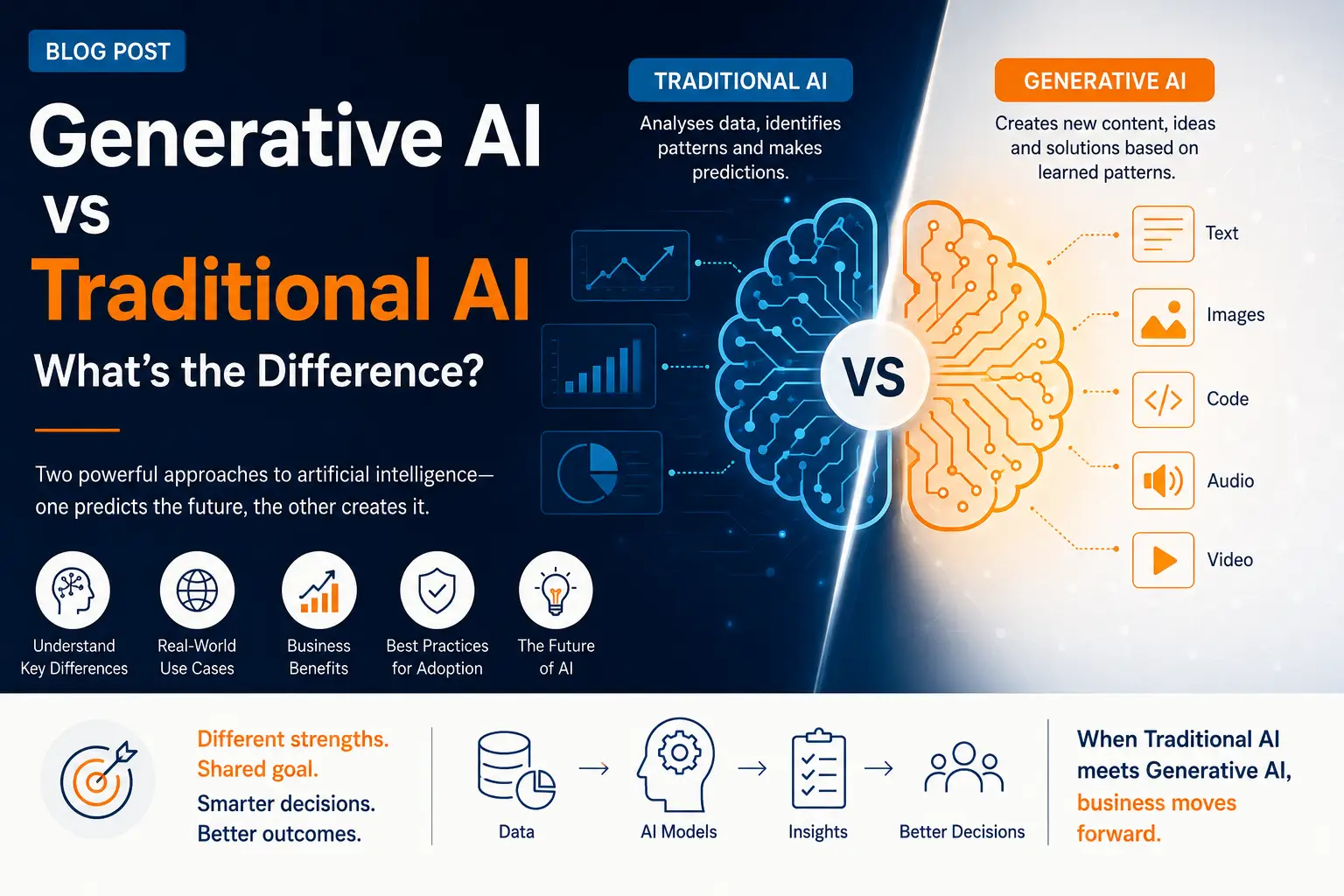
Traditional AI predominantly analyses, predicts, classifies and optimises.
Generative AI interprets context, synthesises information and creates new outputs.
A traditional AI system might answer:
“Which customers have the highest probability of cancelling their service?”
A generative AI system could help explore:
“What factors appear to be contributing to this customer’s dissatisfaction, and what would constitute an appropriate, personalised response?”
The distinction, however, should not be interpreted as a competition between two technologies.
Traditional AI and generative AI can be highly complementary.
Traditional AI can provide the analytical and predictive intelligence required to identify patterns or potential outcomes, while generative AI can help transform those insights into accessible explanations, recommendations, communications and actions.
The strategic opportunity lies in understanding how these capabilities can operate together within intelligently redesigned workflows.
Generative AI has significant implications for modern organisations because many contemporary roles involve substantial amounts of language, information processing, communication and knowledge work.
McKinsey research has identified significant generative AI adoption across functions including marketing and sales, product and service development, service operations, software engineering, IT and knowledge management.
Generative AI can support marketing professionals across research, ideation, campaign development, content creation, personalisation and communication.
Teams can use AI to accelerate initial drafting, analyse information, explore alternative concepts and adapt communications for different audiences.
The greatest value is not necessarily achieved by replacing human creativity. Instead, AI can reduce the time devoted to repetitive production activities, enabling professionals to concentrate more extensively on strategy, audience understanding, creative direction, brand integrity and quality assurance.
Generative AI can augment customer-facing teams by summarising interaction histories, retrieving relevant information, suggesting responses and assisting employees during complex customer conversations.
Traditional AI may identify or classify the nature of a customer enquiry.
Generative AI can help employees interpret that information and formulate an appropriate response.
When implemented responsibly, this combination has the potential to improve service consistency while allowing employees to devote greater attention to situations requiring empathy, judgement and relationship management.
Generative AI is creating substantial opportunities to redefine organisational learning.
Rather than providing every learner with an identical experience, AI-enabled learning environments can support more adaptive and personalised development.
Learners may be able to ask questions, request alternative explanations, practise workplace scenarios, explore concepts interactively and receive support according to their individual requirements.
For organisations, this creates opportunities to deliver learning that is increasingly accessible, contextual, scalable and responsive to workforce needs.
Software professionals can use generative AI to assist with documentation, code explanation, initial code generation, debugging, testing and technical research.
Used effectively, these capabilities can accelerate aspects of development while allowing technical professionals to focus greater attention on architecture, security, quality, problem-solving and strategic decision-making.
Organisations generate enormous volumes of policies, procedures, reports, research and internal documentation.
Locating the correct information can become increasingly difficult as this knowledge base expands.
With appropriate security, governance and information architecture, generative AI can provide conversational access to organisational knowledge, helping employees locate, synthesise and understand relevant information more efficiently.
The AI transformation is not solely technological. It is fundamentally a workforce capability challenge.
The World Economic Forum’s Future of Jobs Report 2025 indicates that employers expect approximately 39% of workers’ existing skill sets to be transformed or become outdated by 2030.
AI and big data are among the fastest-growing skill areas, yet distinctly human capabilities—including analytical thinking, creative thinking, resilience, flexibility, leadership and social influence—remain critically important.
This reinforces an important principle:
Access to artificial intelligence does not automatically create an AI-capable workforce.
Employees require the knowledge and confidence to understand:
When strategically implemented and appropriately governed, generative AI can create meaningful organisational advantages.
Generative AI can accelerate knowledge-intensive activities including research, summarisation, drafting, information synthesis, documentation and content development.
Natural-language interaction reduces technical barriers, allowing a broader proportion of the workforce to engage with sophisticated AI capabilities.
AI can support more tailored communications, learning experiences, recommendations and customer interactions.
Generative AI can assist employees in exploring ideas, challenging assumptions, generating alternatives and accelerating early-stage innovation.
AI-enabled systems can extend access to information, guidance and learning across geographically distributed workforces without requiring human support resources to increase at the same rate.
The capabilities of generative AI are substantial, but they should not be mistaken for infallibility.
Generative AI systems can produce responses that are articulate and persuasive while nevertheless being incomplete, inaccurate, outdated or entirely incorrect.
AI outputs may also reflect biases present within training data, user inputs or broader information environments.
Organisations must therefore carefully consider:
The objective of responsible AI adoption should not be to automate every process that can technically be automated.
Instead, organisations should establish clear parameters regarding where AI creates legitimate value, where human oversight remains essential and where automated decision-making may be inappropriate.
Effective governance must therefore evolve alongside technological adoption.Public discussion surrounding artificial intelligence is frequently framed as a competition between humans and machines.
For organisations, a more strategically useful question is:
What becomes possible when artificial intelligence augments human capability rather than simply attempting to replace it?
Traditional AI can process enormous volumes of data and identify patterns at a scale beyond human capability.
Generative AI can rapidly synthesise information, generate alternatives and support knowledge-intensive activities.
Humans, however, remain essential for interpreting context, exercising judgement, demonstrating empathy, managing relationships, evaluating ethical considerations and assuming accountability for consequential decisions.
The future of work is therefore likely to be defined less by human versus AI and increasingly by human capability amplified by AI.
Organisations that successfully establish this relationship can potentially create a workforce that is not only more productive, but also more capable of concentrating human expertise where it generates the greatest value.
One of the most significant misconceptions surrounding digital transformation is that purchasing sophisticated technology constitutes transformation.
It does not.
Technology represents only one component of organisational change.
McKinsey’s 2025 research indicates that although AI adoption has become widespread, many organisations remain within experimentation and pilot phases rather than achieving enterprise-wide implementation.
Organisations generating greater value from AI are increasingly redesigning workflows rather than simply inserting AI tools into established processes.
Sustainable AI transformation therefore requires an integrated approach encompassing:
People. Process. Technology. Governance.
Organisations must develop workforce literacy, identify meaningful use cases, redesign processes, establish governance frameworks, manage risk and provide employees with practical opportunities to develop confidence using AI within relevant professional contexts.
This represents the transition from having AI technology to developing genuine organisational AI capability.
At DeL AI Group, we recognise that successful AI transformation begins with people.
As artificial intelligence becomes increasingly embedded within contemporary workplaces, organisations require more than access to sophisticated technology. They require leaders and employees who understand how to apply AI intelligently, critically and responsibly.
DeL AI Group enables organisations to progress beyond surface-level AI adoption towards sustainable workforce and organisational capability.
Through digital-enhanced learning, applied AI education and workforce development, DeL supports professionals and organisations in developing the practical knowledge, confidence and competencies required to operate effectively within increasingly AI-enabled environments.
Our approach focuses not simply on teaching people about AI, but on developing their capacity to understand:
The objective is to ensure technology enhances human capability rather than diminishing the importance of human expertise.
The emergence of generative AI does not render traditional AI obsolete.
Both technologies will continue to perform important—and increasingly interconnected—roles.
Traditional AI will remain fundamental to prediction, classification, recommendation, optimisation and automated analytical processes.
Generative AI introduces an additional capability: the ability to synthesise, communicate, create and interact through natural language and other forms of content.
The organisations positioned to derive the greatest value from AI will therefore not necessarily be those deploying the greatest number of technologies.
They will be those capable of making informed decisions about:
Artificial intelligence will continue to evolve, but the fundamental strategic objective remains unchanged:
How can technology enable people and organisations to perform more effectively and create greater value?
Generative AI introduces extraordinary possibilities for knowledge work, communication, learning, innovation and workforce productivity.
Traditional AI continues to provide sophisticated analytical, predictive and optimisation capabilities.
When these technologies are deployed responsibly—and supported by appropriate governance, workforce capability and human oversight—they can contribute to more informed decision-making, enhanced productivity, personalised learning and entirely new approaches to work.
The next phase of AI transformation will therefore extend well beyond technological implementation.
It will require organisations to cultivate the skills, leadership, governance, culture and workforce confidence necessary to convert technological potential into sustainable organisational value.
The organisations that begin developing those capabilities today will be better positioned to navigate—and lead—the increasingly AI-enabled economy of tomorrow.
The question is no longer whether artificial intelligence will influence the future of work. The challenge is determining how effectively your organisation and workforce are prepared to operate within it.
DeL AI Group supports organisations in developing practical AI capability through digital-enhanced learning, workforce development and applied AI education designed for the evolving world of work.
Speak with the DeL AI Group team to explore how your organisation can build a confident, capable and responsible AI-ready workforce.Chandra has a long-standing record of professionalism and integrity in the Vocational and Higher education sectors in Australia spanning over 2 decades. He holds a Master’s Degree in Computer Science and a Bachelor’s degree with Distinction in Information Technology majoring in software engineering, and is also a certified trainer & qualified assessor.
He has served in key roles in various organisations across both the higher education and vocational sectors which include Vice President, Academic Director, Deputy Principal, Director of Studies, Managing Director and Marketing Director. He has also set up and managed his own fully accredited RTO.
Chandra is managing and overseeing the entire operations of The Business School, both onshore and offshore for the VET and ELICOS sectors. Some of these would include marketing, student recruitment, IT, admissions, student support departments as well as coordinating with the Director of Studies and the Academic Manager to ensure competency and quality are maintained across academics, trainers, and teachers.

Christopher is a future-focused educator and global business leader committed to reshaping how people learn, upskill and succeed. Driven by innovation, he combines technology, digital learning design and real-world industry insight to build powerful, future-ready education solutions.
As Director General of the World Certification Institute and an experienced Company Director, he leads international initiatives that set global standards, strengthen professional capability, and open new pathways for learners across Asia and beyond. His work bridges education and enterprise — helping organisations transform their workforce and individuals gain the skills and confidence to thrive in a changing world.
With qualifications including BCom, GradDipEd, MBA, FCPA, WCMP and FWCI, I bring deep expertise in business strategy, financial governance and competency-based learning.
Christopher is passionate about using technology to enhance the learning journey, create equitable access to skills, and promote lifelong learning for all.
Our mission is simple: to empower people with the knowledge, tools and opportunities they need to succeed — today and into the future.
For any further details, please fill in the enquiry form below to reach us.